Island of Rab & surroundings
Location and geography
Location and access
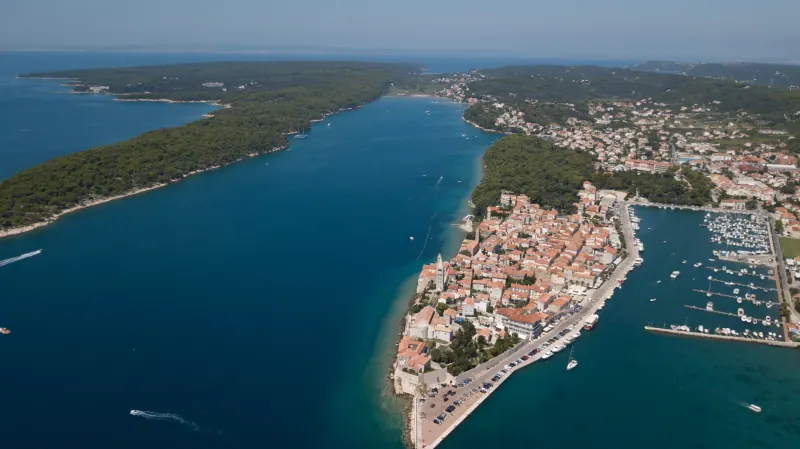
Rab lies in the Kvarner Bay in the north of Croatia, sheltered between the mainland and its neighbouring islands of Pag and Krk. The island measures around 90 square kilometres and, with a good 8,000 inhabitants, is one of the liveliest islands in the northern Adriatic — big enough for variety, small enough to really get to know in a week.
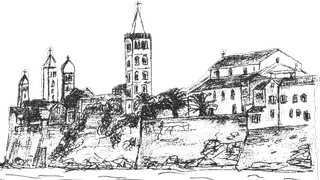
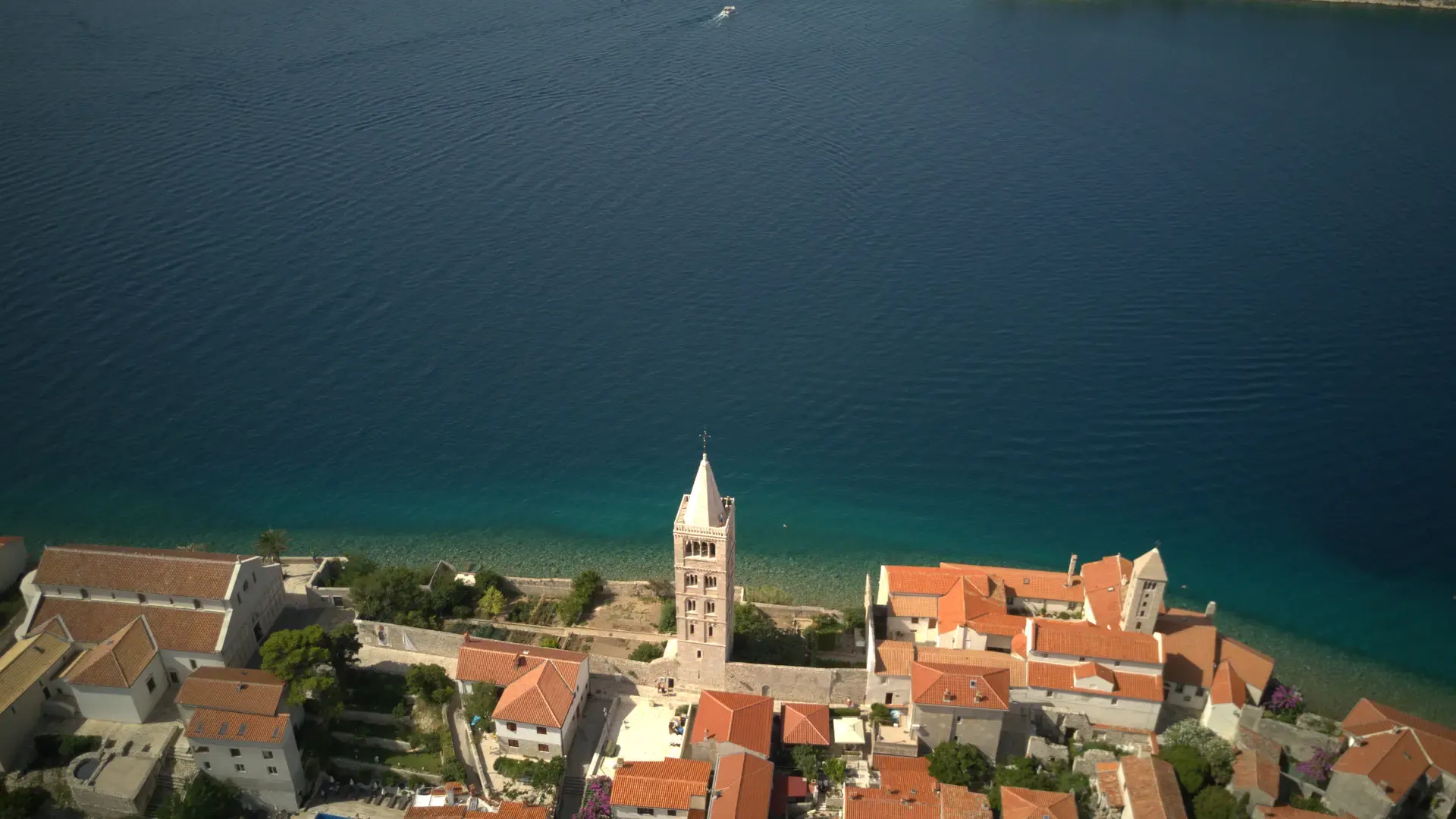
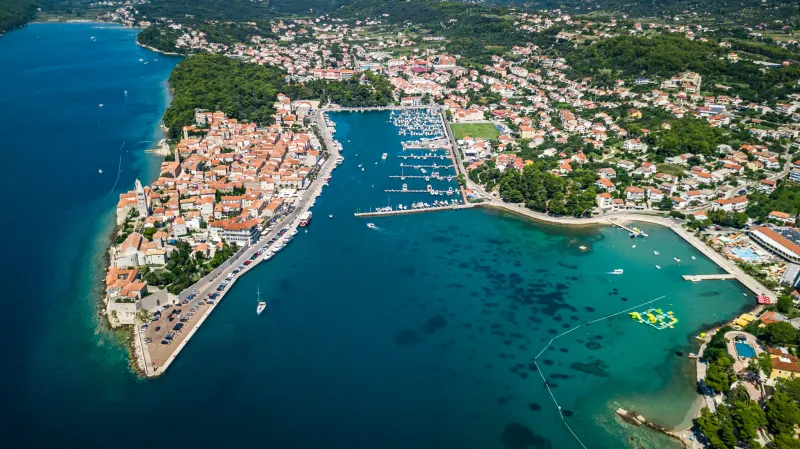
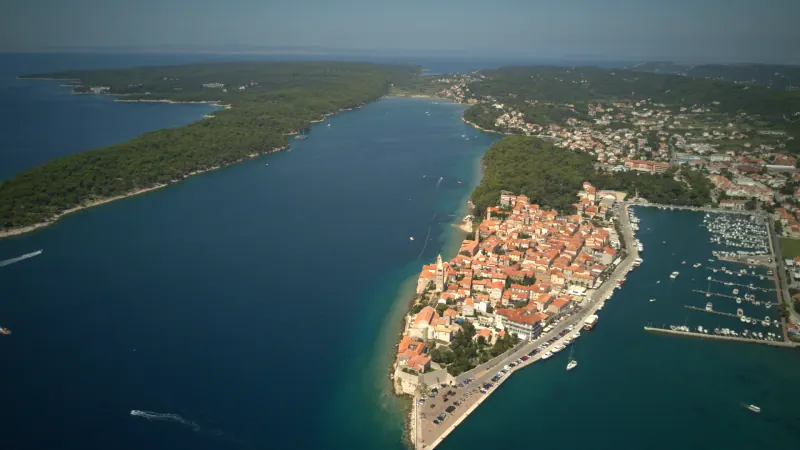
Its centre is the town of Rab, whose old town sits on a narrow peninsula: four Romanesque bell towers in a row, the sea behind them — the silhouette that has made the island known as the “Pearl of the Adriatic”. We live in Banjol, the neighbouring village right on the bay, about 20 minutes on foot from the old town.
Anyone wanting to explore the island manages perfectly well without a car: bus routes connect the larger villages, water taxis take you to bays that are barely reachable by land, and the coastal paths are wonderful for cycling. Krk, Pag and the Plitvice Lakes National Park are all within reach for day trips.
Climate and the best time to travel
Rab has a Mediterranean climate with hot, dry summers and mild winters. The Kvarner Bay softens the extremes: in July and August daytime temperatures are mostly between 28 and 32 degrees, and the sea reaches a pleasant 24 to 26 degrees in August and September.
June and September are our favourite months — warm enough for swimming, but without the crowds of high season, and you can still sit outside long into the evening. May and October bring 20 to 25 degrees and are especially good for walking, cycling and visiting the town.
In winter the thermometer rarely drops below freezing, though it rains more often in November and December. Now and then the bora blows, a dry downslope wind off the mainland — it clears the sky and can briefly upset the ferry timetables.
The most beautiful beaches: Lopar sandy beach, Suha Punta, Pudarica
Your local beach is Padova 1, just 300 metres from our house: a gently shelving sand-and-shingle entry, ideal even with small children, with a bar and sunloungers within walking distance.
Rab is famous for the sandy beaches around Lopar in the north. Rajska plaža (“Paradise Beach”) stretches 1.5 kilometres into the shallow sea — you wade a long way out before it gets deep. If you prefer things quieter, walk on from there for 15 to 30 minutes to the smaller bays of the Lopar peninsula, among them Sahara and Ciganka.
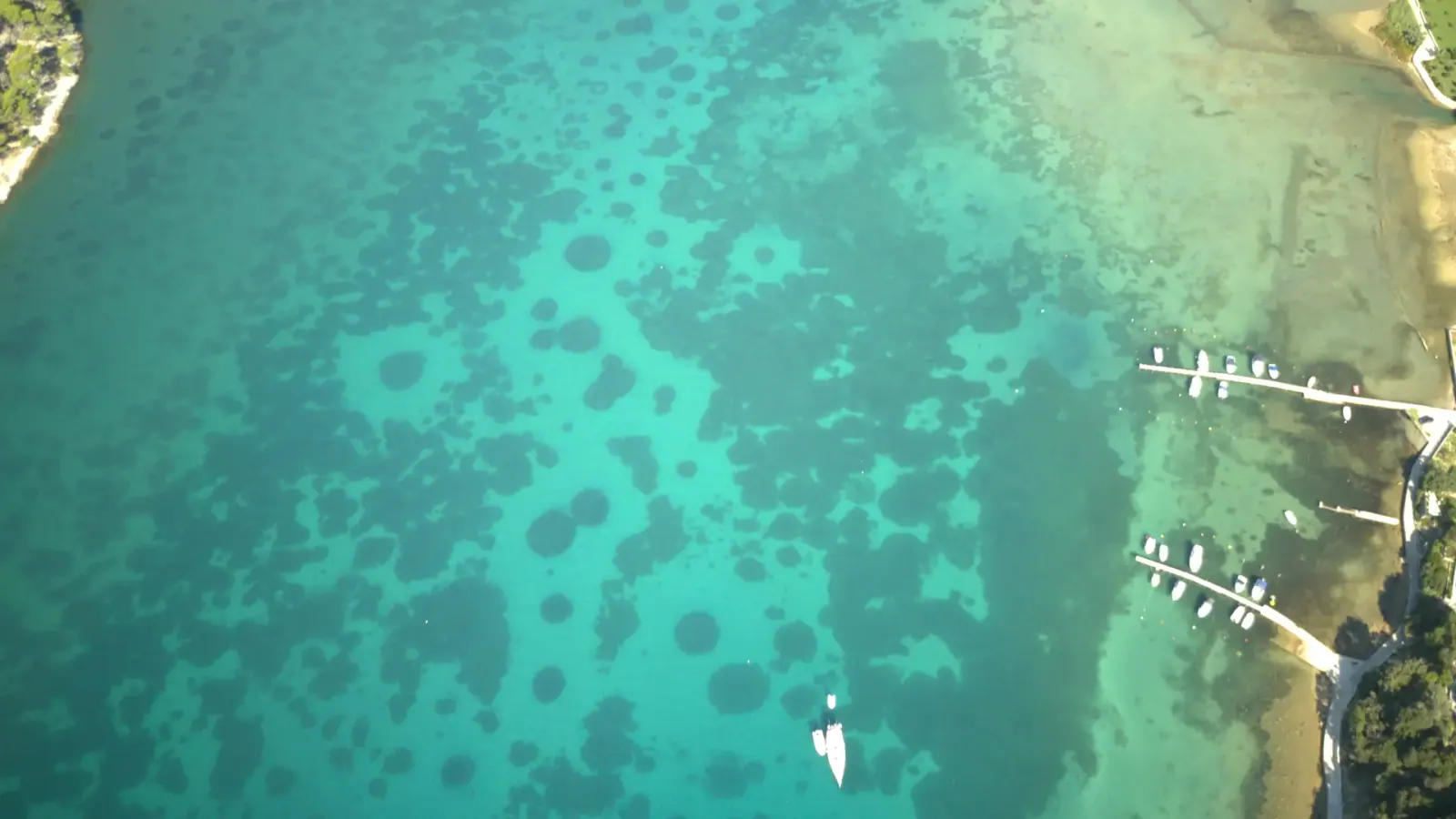
To the west lies Suha Punta between pine woods: rocky entries, clear deep water and plenty of shade — the best address for snorkelling. Kampor, on the bay of the same name, is shallow and sheltered from the wind, while Pudarica in the south is especially lovely at sunset.
Most of the island’s beaches fly the Blue Flag. Water shoes are practical on the shingle bays; on the sandy beaches in the north you will not need them.
Nature and landscape
Rab is divided in two: the north-east is screened off by a barren ridge, behind which the sheltered, green side of the island opens out — pine woods, olive groves and vineyards running right down to the water.
Park Komrčar begins directly beside the town, a wooded park from the 19th century with shady paths down to the coast. From there, waymarked trails carry on towards Suha Punta and Kampor.
The barren east with the Kamenjak ridge is worth the climb: in clear conditions you look out from the highest point across half of the Kvarner Bay as far as the Velebit mountains on the mainland. Sheep still graze here between the dry-stone walls — which is precisely why lamb from Rab is a local speciality.
The coastline changes constantly: rocky cliffs in the north-east, wide sandy bays at Lopar, and in between small shingle coves you can only reach on foot or by boat. That alone makes a day out with a water taxi worthwhile.
History and culture
History of the island
Rab’s history begins with the Illyrians and becomes Roman from the 1st century BC: Emperor Octavian granted the town the status of a municipium — the inscription “Felix Arba” (happy Rab) gave the island its byname.
From the 12th century until the end of the 18th, Rab belonged, with interruptions, to the Republic of Venice. That period produced the picture that still shapes the old town today: the town wall, the palaces along the main lane and the four bell towers, which come from different centuries and yet look like a single composition.
After the end of Venice the island passed to Austria-Hungary, and after the First World War to the Kingdom of Yugoslavia. In the Second World War Italian troops occupied the island and set up an internment camp near Kampor — a memorial there commemorates the victims.
Tourism began unusually early on Rab: as far back as 1889 the island was officially declared a health resort, and in the 1930s a prominent bathing guest made Rab known internationally. Naturist bathing has been a matter of course here since 1936.
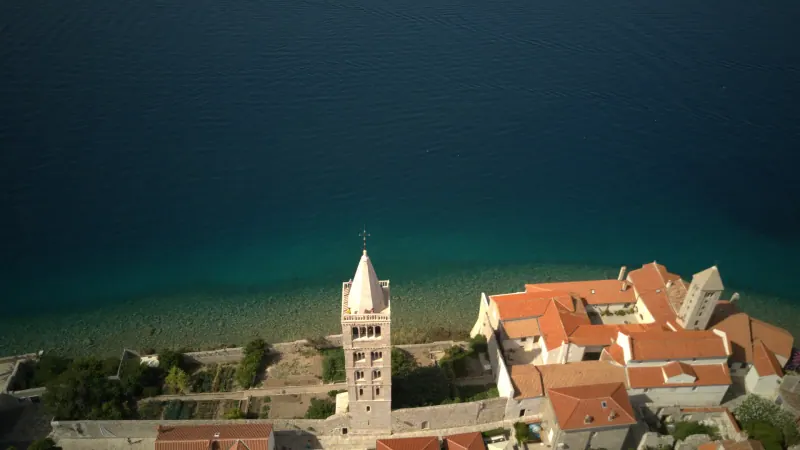
Sights on Rab: the old town and surroundings
The old town can be explored on foot in an afternoon — these are the places you should not leave out along the way:
The four bell towers
The island’s landmark: four Romanesque campanili in a row along the Upper Lane. The tallest belongs to St Mary’s Cathedral and can be climbed — from the top you can see the entire peninsula and, in clear weather, as far as the Velebit.
St Mary’s Cathedral
The Romanesque church of St Mary from the 12th century, with its striped façade, stands at the highest point of the old town. In summer the Rab Musical Evenings take place here — classical concerts in a space with exceptional acoustics.
Monastery of St Euphemia
The Franciscan monastery of Kampor, a few kilometres outside the town, dates from the 15th century. Worth seeing are the quiet cloister, the library and the collection of sacred art.
Park Komrčar
The wooded park below the town wall was laid out in the 19th century and is today the shadiest way down to the water — with a view over the harbour and a swimming cove at the end of the path.
Kampor Memorial
The complex designed by Edvard Ravnikar commemorates the Italian internment camp of the Second World War. A quiet, rewarding place away from the tourist routes.
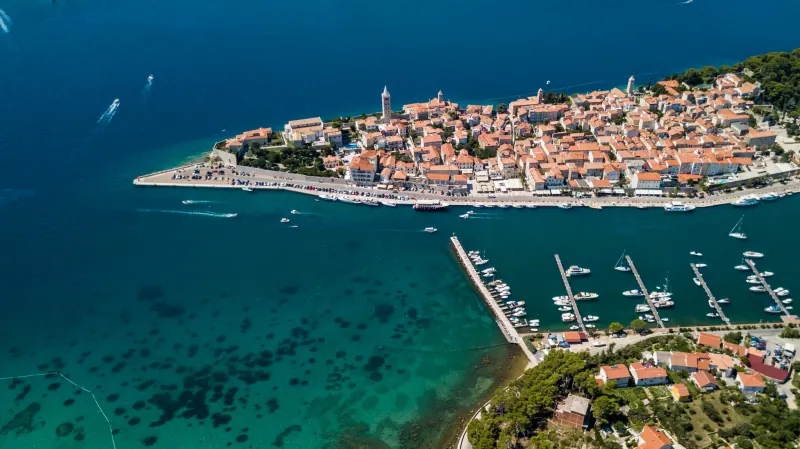
Festivals and traditions
The high point of the summer is the Rabska Fjera at the end of July: for three days the old town becomes a medieval market — craftspeople work in historical costume, music groups play in the evenings, and the island’s crossbowmen compete against one another. What is celebrated is the granting of the town charter in 1364.
From May to September the Rab Musical Evenings are held in the cathedral and the Church of the Holy Cross — chamber music and choral concerts in historic surroundings, usually with free admission.
The Rab Carnival in February is one of the oldest in Croatia: masks, parades and, at the end, the burning of “Krnjo”, who symbolically carries the blame for everything that went wrong during the year.
Autumn turns culinary: the Fishermen’s Days in September celebrate the catch with grilled fish and local wine at the harbour, the Olive Oil Fair in November the island’s freshly pressed olive oil.
Activities and leisure
On and in the water
The water around Rab is exceptionally clear — visibility of 20 metres and more is normal. Diving centres on the island offer courses from taster dives to certification and head out to wrecks, drop-offs and caves; for snorkellers the rocky shores at Suha Punta and Kampor are ideal.
Sailors will find two ACI marinas on Rab (Rab and Supetarska Draga) and plenty of anchorages in the bays. If you are bringing your own boat: we have a mooring free on our property by arrangement.
The windy north coast near Lopar is good for surfing and kiting, and in the sheltered bays you can hire a SUP, kayak or pedalo right on the beach. Jet skis and parasailing are available at the larger beaches, and boat trips to the neighbouring islands leave the harbour daily.
Our tip: hire a water taxi for half a day and head for the bays in the north that cannot be reached by land — you will often have a whole beach to yourselves.
On foot and by bike
Rab is well served with over 100 kilometres of waymarked paths. The best known is the Premužić trail along the Kamenjak ridge: just under two hours of climbing, with a panorama at the top across the Kvarner Bay as far as the Velebit. Far gentler is the coastal path between Banjol, the old town and Suha Punta — flat, shady and especially lovely in the evening.
Cyclists will find quiet routes through pine woods and olive groves on the green side of the island; the Banjol – Kampor – Supetarska Draga route can be ridden in half a day. There are rental stations in the town of Rab and in Lopar, e-bikes included.
For the summer the rule is: set off early or late. Between 11 a.m. and 4 p.m. it is very hot on the open sections — take enough water with you, as there is hardly anywhere to stop along the way. We have maps and route suggestions here for you.
Food and drink
What you should have tried
The Rapska torta is the sweet speciality of the island: a spiral-shaped almond and maraschino cake handed down since the 12th century and originally baked for distinguished visitors. You will find it in the patisseries of the old town, also by the slice to take away.
From the karst comes the lamb: Janjetina, cooked on the spit or under the bell (ispod peke), is the classic of the island’s kitchen. Because it takes so long to prepare, you should order it a day in advance — we are happy to take care of the booking for you.
From the sea: Brodet, a fish stew with tomato and garlic, served with polenta. Or simply the catch of the day from the grill, with olive oil and Blitva (chard with potatoes) — it hardly gets simpler or better.
For dessert, Fritule, little doughnuts with raisins and lemon zest. With them a glass of the local white wine or a drop of Travarica, the herb brandy of the region.
Where we eat ourselves
In the old town the restaurants stand side by side — from the simple konoba with the day’s catch to fine dining. The terraces facing the harbour fill up from 8 p.m.; anyone coming without a reservation should be there earlier.
You eat far more peacefully and often better in the neighbouring villages: in Banjol, Barbat and Supetarska Draga, small family-run places cook with whatever the day brings. Here you usually sit with a view of the water and pay noticeably less than in town.
Towards evening the walk into the old town is worth it: bars right on the waterfront promenade, plus a few clubs for the late hours. If you prefer things quieter, have an aperitif on one of the roof terraces looking out over the bell towers.
Just tell us what you fancy — we know the hosts, we will recommend the right address and are glad to book the table.
We are happy to make table reservations for you.
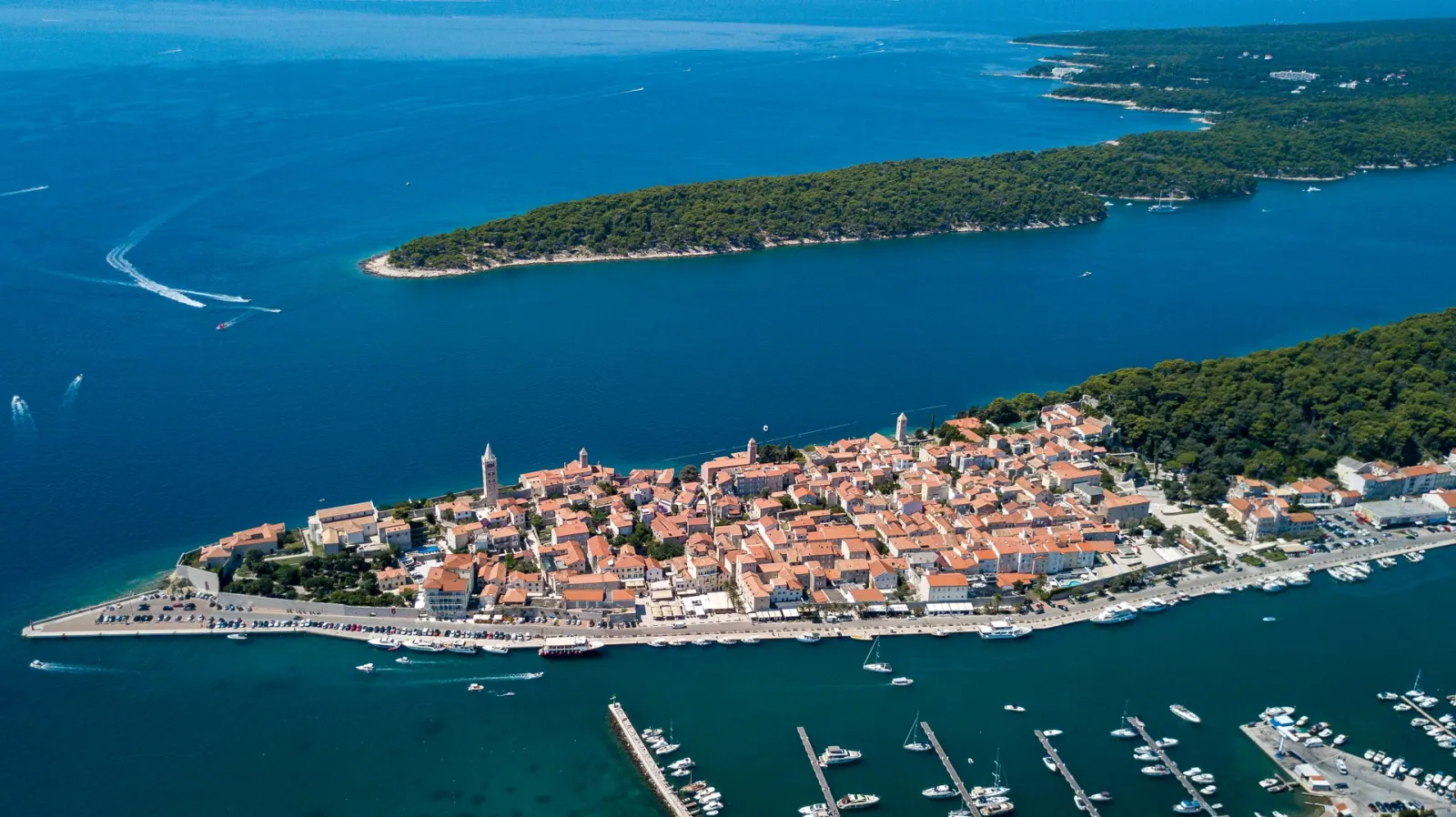
Getting to the island of Rab
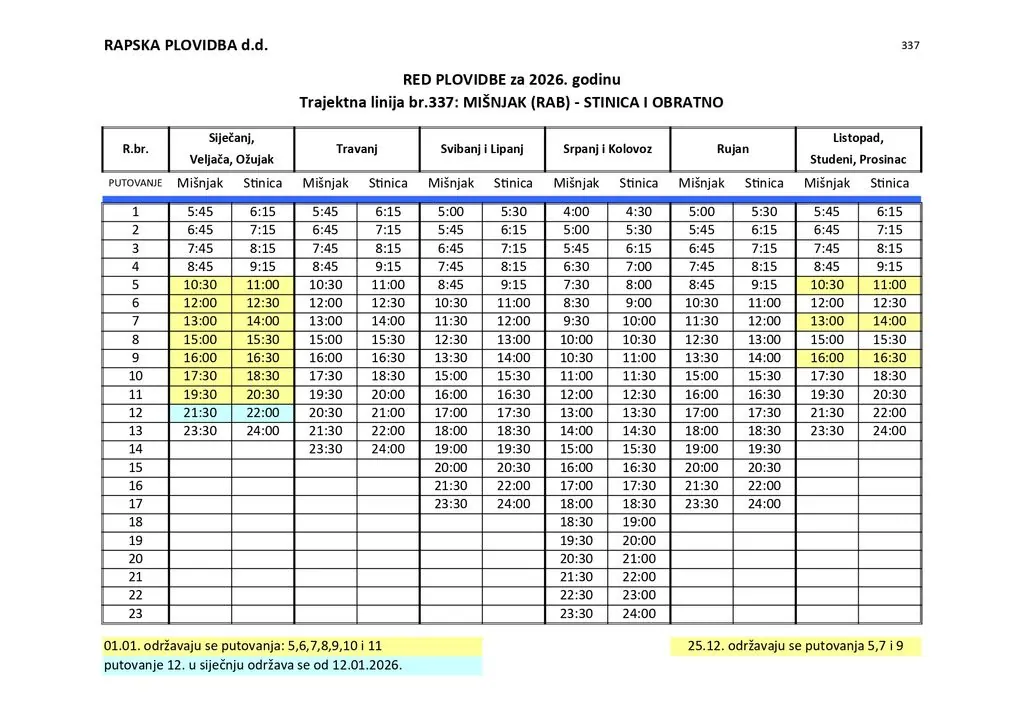
Rab can be reached by ferry all year round: from the mainland at Stinica in around 15 minutes to Mišnjak, or via the island of Krk from Valbiska in about 75 minutes to Lopar. In high season both routes run considerably more often than in winter.
From Germany and Austria you drive through Slovenia to Rijeka and then south on the coastal road E65 to Stinica (around 80 km from Rijeka). From there the ferry crosses to Mišnjak on Rab — the crossing takes about 15 minutes. From Mišnjak it is another 25 minutes by car to Banjol. In high season it pays to travel early in the day: in the afternoon the queue at the ramp can mean waiting for one or two departures. There is no reservation — you join the queue and pay at the booth.
The alternative without the long coastal road: over the Krk bridge onto the island of Krk and on to Valbiska, from there with Jadrolinija to Lopar in the north of Rab (around 75 minutes crossing, several times a day). From Lopar to Banjol is about 20 minutes by car. When the bora is blowing on the coastal road, this route is the more relaxed choice.
The nearest airport is Rijeka (RJK) on the island of Krk, around two hours’ drive away and served from several European cities in summer. Zagreb (approx. 3 hrs), Pula (approx. 2.5 hrs) and Zadar (approx. 2.5 hrs) also have good connections all year round. We recommend a hire car from the airport — on the island itself you will get around perfectly well by bus, bike and water taxi.
Long-distance coaches run from Zagreb and Rijeka directly into the town of Rab (ferry included). By train you travel as far as Rijeka and change there onto the bus. We are happy to pick you up from the bus station in Rab if you wish — just let us know in advance.
Ferry to Rab: Stinica–Mišnjak and Valbiska–Lopar (timetable 2026)
Timetable for the 2026 season — please check on rapska-plovidba.hr shortly before you travel, as the times change between the early, main and late season.
The connection from Krk to Lopar is operated by Jadrolinija. Departure times change with the season — you will find the current timetable and tickets directly with the operator.
View the timetable at Jadrolinija →Weather on the island of Rab
To help you plan, we run our own weather dashboard for Rab: a forecast drawn from up to nine weather models, wind and gusts (important when the bora blows), sea temperature, rain radar and the official warnings of the Croatian met service DHMZ — updated hourly.
As a rule of thumb: the swimming season runs from late May to early October, and in August and September the sea is 24 to 26 degrees. The bora blows mainly in the winter half of the year and can suspend the Stinica–Mišnjak ferry for a few hours — the dashboard shows the gusts for the coming days.
Frequently asked questions about the island of Rab
How do you get to the island of Rab?
Rab has no bridge, so you always arrive by car ferry: from the mainland at Stinica to Mišnjak (around 15 minutes, Rapska Plovidba, no reservations — you simply queue up) or from the island of Krk at Valbiska to Lopar (around 75 minutes, Jadrolinija). Both lines run all year, far more frequently in summer.
Where are the sandy beaches on Rab?
The big sandy beaches are in the north around Lopar: Rajska plaža (“Paradise Beach”) and the smaller bays of Sahara and Ciganka. Our local beach Padova 1 in Banjol, 300 metres from the house, has a gently shelving sand-and-shingle entry and is ideal with small children.
When is the best time to visit Rab?
June and September: warm enough for swimming, but without the crowds of high season. In July and August daytime temperatures are 28 to 32 degrees, and the sea is 24 to 26 degrees in August and September. May and October, at 20 to 25 degrees, are especially good for walking and cycling.
How long does the drive take?
From Rijeka it is around 80 kilometres of coastal road to the ferry at Stinica, then a 15-minute crossing and about 25 minutes by car from Mišnjak to Banjol. When the bora is blowing on the coastal road, the route over the Krk bridge and the Valbiska–Lopar ferry is the more relaxed choice.
Do you need a car on Rab?
No. Bus routes connect the larger villages, water taxis take you to bays that are barely reachable by land, and the coastal paths are wonderful for cycling. From Banjol the old town of Rab is a 20-minute walk.
Is there a boat mooring at the apartment?
Yes — if you arrive with your own boat, a mooring right at our property is available by arrangement for a small surcharge. Your trailer stays in the car park in front of the house. As there are only a few berths, please ask early.
Are dogs allowed in the apartments?
Pets are welcome on request and for an extra charge.